
Wolf Spider vs Brazilian Wandering Spider
Spiders comprise an extremely diverse group of animals with hundreds of millions of years of evolutionary history. Since their emergence about 350 million years ago, they have varied in size, color, shape, and behavior, adapting to all habitats and spreading across nearly every terrestrial environment, totaling over 30,000 species worldwide1. Brazil is the neotropical country with the greatest diversity, with more than 3,000 known species2.
Despite the fear that people have developed toward these animals, most are discreet and avoid contact with humans, spending much of their time performing their silent role in nature. Spiders are important predators in all ecosystems they inhabit, with a great capacity to find and consume more prey than any other predator. Although they feed mainly on insects, larger species can also feed on small mice, bats, fish, crabs, frogs, lizards, snakes, and scorpions, and they serve as food for many birds and wasps. Thus, spiders help maintain the biotic balance of nature1.
Although spiders are generally called “dangerous,” this idea does not reflect reality. Most species pose no significant risk to humans, and only a very small fraction has venom capable of causing serious reactions in people34. Therefore, non-dangerous spiders are the majority, and although almost all have venom—a very important tool for their feeding that allows them to immobilize small prey such as insects—it is usually too weak to affect humans. Furthermore, many species cannot even pierce human skin with their chelicerae. Most spiders avoid contact and only bite in extreme situations, such as when pressed against the body5.
Those considered dangerous to humans are quite specific, such as the brown recluse , black widows (and to a lesser extent brown widows), and wandering spiders . Even in the case of these species, it is important to note that they are not aggressive by nature. Bites usually occur accidentally, such as when putting on a shoe or handling objects where the spider was hiding.
While many spiders have striking colors and distinctive patterns, others can be quite similar, making identification more challenging. Still, with some attention, we can notice characteristics that allow us to differentiate them—as is the case with wolf spiders and wandering spiders. Recognizing the differences between the two groups can help avoid unnecessary worries or wrong decisions, such as trying to kill a spider that could actually be beneficial or, conversely, underestimating a truly dangerous animal.
Wolf Spiders
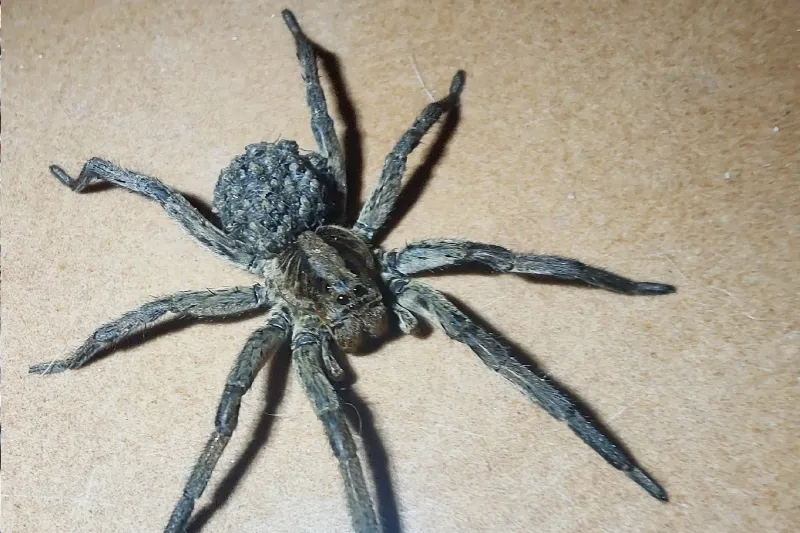
Wolf spiders, or garden spiders, are solitary, generally do not build webs, and are known for carrying their young on top of their abdomens. Body size can vary by species, reaching up to 5 cm5 without legs, and their coloration is brown and/or black. They can be identified by light longitudinal lines on the cephalothorax and abdomen, where they form an arrow-like pattern in most species.
Despite their small size and difficulty in visualization, they can also be identified by the positioning of their eyes. Almost all spiders have eight eyes, arranged differently in each family. In wolf spiders, there are two eyes on the front of the cephalothorax (where the head is located) and two others laterally positioned, being large and prominent, while four other smaller eyes are lined up horizontally just below these6.
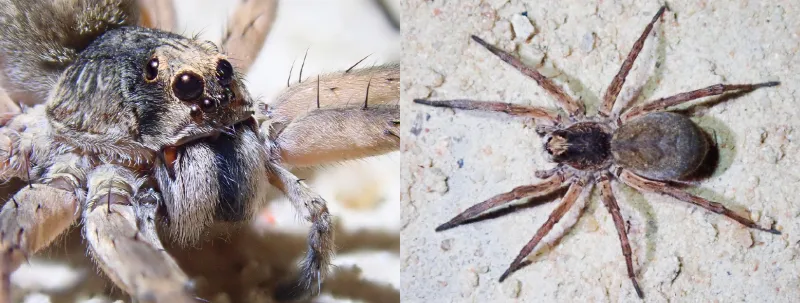
Although these spiders may occasionally bite humans, they are not dangerous and only bite when they feel threatened, are accidentally pressed against the body, or are mishandled. Wolf spider bites usually cause only mild redness and itching7. Wolf spiders are a vital source of natural pest control in gardens and homes, as they attack pests such as cicadas, ants, caterpillars, stink bugs, cockroaches, and other arthropods8.
Brazilian Wandering Spiders
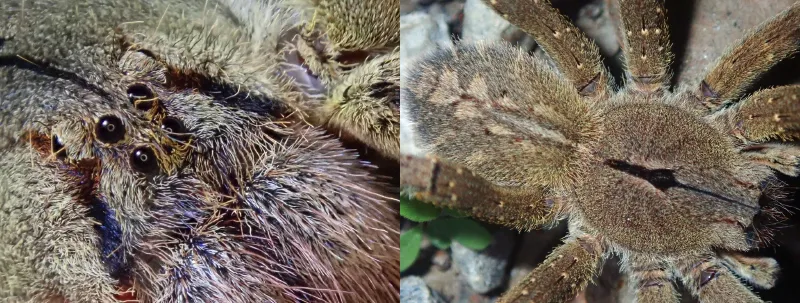
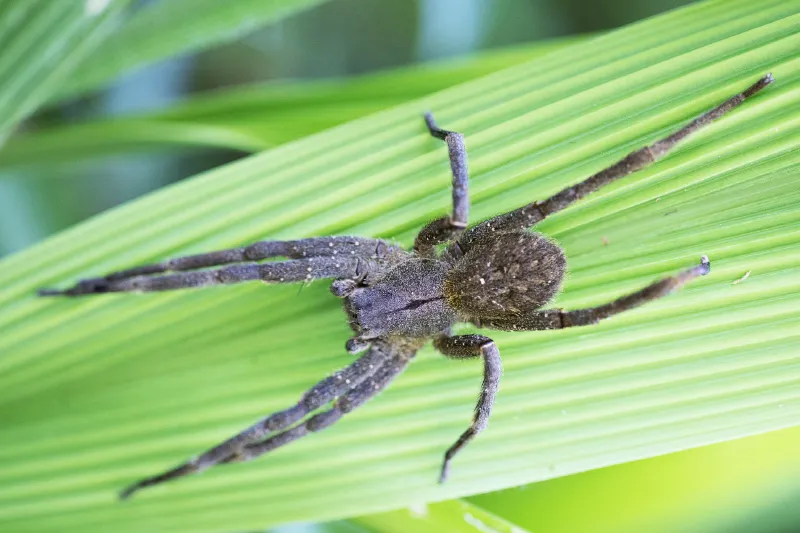
Wandering spiders, also called banana spiders, share certain similarities with wolf spiders, such as size9 and the habit of walking on the ground instead of building webs. However, they can be differentiated by having a thin dark line on the cephalothorax. Additionally, many species have a heart-like pattern on the abdomen. Although not equally noticeable, many have reddish chelicerae; however, the most determining characteristic is the positioning of the eyes, having 4 small eyes positioned at the front of the head (like on a die) and 2 small eyes on each side10.
Wandering spiders are famous for adopting a characteristic defensive posture with the two front pairs of legs held raised while the spider sways from side to side on its hind legs9. However, it is important to note that many other species can adopt the same posture11 (such as wolf spiders and tarantulas, which are also not considered medically significant spiders), and this characteristic alone is not sufficient to confirm it is a wandering spider.
Wandering spiders are among the few species known to pose a threat to humans. They are found throughout Brazil (except in the northeast) and, although they are wandering spiders with nocturnal habits, they demonstrate great adaptability to human-modified environments, being frequently found in urban areas.
Dark places are ideal hiding spots during the day, including inside shoes, in banana bunches, in piles of wood, twigs, debris, or construction materials, and if accidentally disturbed, they may bite. In most cases, bite symptoms include: pain, swelling, redness, and tingling. In more severe or moderate cases, sweating, tachycardia, vomiting, hypertension, or hypotension may occur. Critical cases can lead to cardiac and respiratory complications.
The vast majority of cases (89.8%) are classified as mild. Moderate and severe accidents (8.5% and 0.5% respectively) occur mainly in children and the elderly. In addition to the clinical conditions mentioned, it is important to note the occurrence of asymptomatic cases, which correspond to the dry bite phenomenon. In these rare situations, the spider bites the individual but no venom injection occurs, resulting in the complete absence of local or systemic manifestations. Because they do not present pain or complications from envenomation, patients classified in this category generally do not require the use of analgesics or other specific medical treatments12.
If a wandering spider bite is suspected, speed of care is essential, especially for children and the elderly. The venom acts quickly on the nervous system, so follow guidelines based on public health protocols. The first step should be to wash the bite site only with water and neutral soap to prevent secondary infections, keeping the affected limb elevated. Unlike other accidents, the use of warm compresses at the site can help relieve intense pain until medical attention is reached.
It is crucial to seek medical assistance immediately at an emergency room. Under no circumstances should tourniquets, bandages, cuts at the bite site, or attempts to suck out the venom be made, as these practices do not prevent toxin absorption and increase the risk of necrosis and serious infections. The application of home substances such as tobacco or alcohol and the ingestion of alcoholic beverages, which can accelerate venom circulation, should also be avoided.
At the hospital, professionals will control pain with anesthetics and, if necessary, administer specific anti-arachnid serum, constantly monitoring blood pressure and heart rate to ensure clinical stabilization13.
Understanding these distinctions and safety protocols are fundamental steps to replace panic with conscious respect. Although wandering spiders require caution, wolf spiders and the vast majority of other species are silent allies that perform essential functions in environmental balance.
As natural insect predators, they control populations that could otherwise become agricultural pests or vectors of human diseases. Therefore, recognizing this diversity and understanding the biotic role of spiders not only ensures individual safety in cases of real risk but also promotes a more balanced relationship with nature, allowing the preservation of animals that are vital to the health of ecosystems.
| Characteristic | Wolf Spider (Family Lycosidae) | Wandering Spider (Genus Phoneutria) |
|---|---|---|
| Abdomen Identification | May have an arrow or spear-like pattern formed by lines. | Central spot patterns that may resemble hearts. |
| Cephalothorax Marking | Brown/black coloration with light and dark bands, may have radial bands. | Thin dark line running lengthwise. |
| Chelicerae Color | Frequently in shades of brown or black. | Frequently reddish or pinkish. |
| Eye Arrangement | 2 large frontal eyes, 2 lateral, and 4 small ones below in a line. | 4 central eyes forming a square and 2 on each side. |
| Parental Care | Carries spiderlings on the abdomen. | Does not exhibit this behavior. |
| Health Risk | Low (mild local reaction—redness and itching). | High (potent venom, requires medical attention). |
References:
-
M.P, Sugumaran; K, Natarajan; G, Porkodi; G, Gayathry; J, Jayakumar; K, Kalaichelvi; K, Suganya; S, Akila; M, Sindhuja. Spiders as Natural Pest Controllers: Insights into Their Distribution, Diversity, and Ecological Impact in Agriculture. Journal of Applied Life Sciences International, [S. l.], v. 27, n. 5, p. 1–9, 2024. DOI: https://10.9734/jalsi/2024/v27i5655. ↩︎ ↩︎
-
BRESCOVIT, A. D.; OLIVEIRA, U. DE .; SANTOS, A. J. DOS .. Aranhas (Araneae, Arachnida) do Estado de São Paulo, Brasil: diversidade, esforço amostral e estado do conhecimento. Biota Neotropica, v. 11, p. 717–747, jan. 2011. DOI:https://doi.org/10.1590/S1676-06032011000500035. ↩︎
-
NENTWIG, Wolfgang; KUHN-NENTWIG, Lucia. Spider Venoms Potentially Lethal to Humans. In: NENTWIG, Wolfgang (ed.). Spider Ecophysiology. Berlin; Heidelberg: Springer, 2013. p. 253–264. DOI: https://doi.org/10.1007/978-3-642-33989-9_19 . ↩︎
-
LEMELIN, Raynald Harvey; YEN, Alan. Human–Spider Entanglements: Understanding and Managing the Good, the Bad, and the Venomous. Anthrozoös, v. 28, n. 2, p. 215–228, 2015. DOI: https://10.1080/08927936.2015.11435398. ↩︎
-
MUSEU DE HISTÓRIA NATURAL – MHN/UFLA. Lycosa erythrognatha — Aranha-lobo (Lycosa sp.). Lavras: Museu de História Natural, Universidade Federal de Lavras, 2023. Available at: https://museus.ufla.br/documentacao_mhn/index.php/animais/lycosa-sp-2/ ↩︎ ↩︎
-
BRITANNICA, The Editors of Encyclopedia. Wolf spider. Encyclopedia Britannica. Last updated: Nov. 21, 2025. Available at: https://www.britannica.com/animal/wolf-spider ↩︎
-
LÜDDECKE, Tim; HERZIG, Volker; VON REUMONT, Björn M.; VILCINSKAS, Andreas. The biology and evolution of spider venoms. Biological Reviews of the Cambridge Philosophical Society, v. 97, n. 1, p. 163–178, 2022. DOI: 10.1111/brv.12793. Available at: https://onlinelibrary.wiley.com/doi/full/10.1111/brv.12793 . ↩︎
-
EDGAR, W. D. Prey and predators of the wolf spider Lycosa lugubris. Journal of Zoology, v. 159, n. 4, p. 405–411, 1969. DOI: https://10.1111/j.1469-7998.1969.tb03897.x. ↩︎
-
GUÉRIN, Christian. The non‑Amazonian species of the Brazilian wandering spiders of the genus Phoneutria Perty, 1833 (Araneae: Ctenidae), with the description of a new species. Zootaxa, v. 1526, n. 1, p. 1–??, Jul. 2007. DOI: https://10.11646/zootaxa.1526.1.1. ↩︎ ↩︎
-
VETTER, Richard S.; HILLEBRECHT, Stefan. Distinguishing two often‑misidentified genera (Cupiennius, Phoneutria) (Araneae: Ctenidae) of large spiders found in Central and South American cargo shipments. American Entomologist, v. 54, n. 2, p. 88–93, Apr. 2008. DOI: https://10.1093/ae/54.2.88. ↩︎
-
Kaya, Rahsen & Özkütük, Recep Sulhi & Kunt, Kadir. (2021). Observations on defensive behaviour of the spider Lachesana blackwalli (Araneae: Zodariidae). SERKET The Arachnological Bulletin of the Middle East and North Africa. 18. 152-156. Available at: https://www.researchgate.net/publication/356290026 . ↩︎
-
BUCARETCHI, Fábio; DEUS REINALDO, Cláudia Regina; HYSLOP, Stephen; MADUREIRA, Paulo Roberto; DE CAPITANI, Eduardo Mello; VIEIRA, Ronan José. A clinico‑epidemiological study of bites by spiders of the genus Phoneutria. Revista do Instituto de Medicina Tropical de São Paulo, v. 42, n. 1, p. 17–21, 2000. DOI: https://10.1590/S0036‑46652000000100003. ↩︎
-
Secretaria da Saúde. Acidentes por Aranhas. Available at: https://www.saude.pr.gov.br/Pagina/Acidentes-por-Aranhas . Accessed: Jan. 14, 2026. ↩︎